

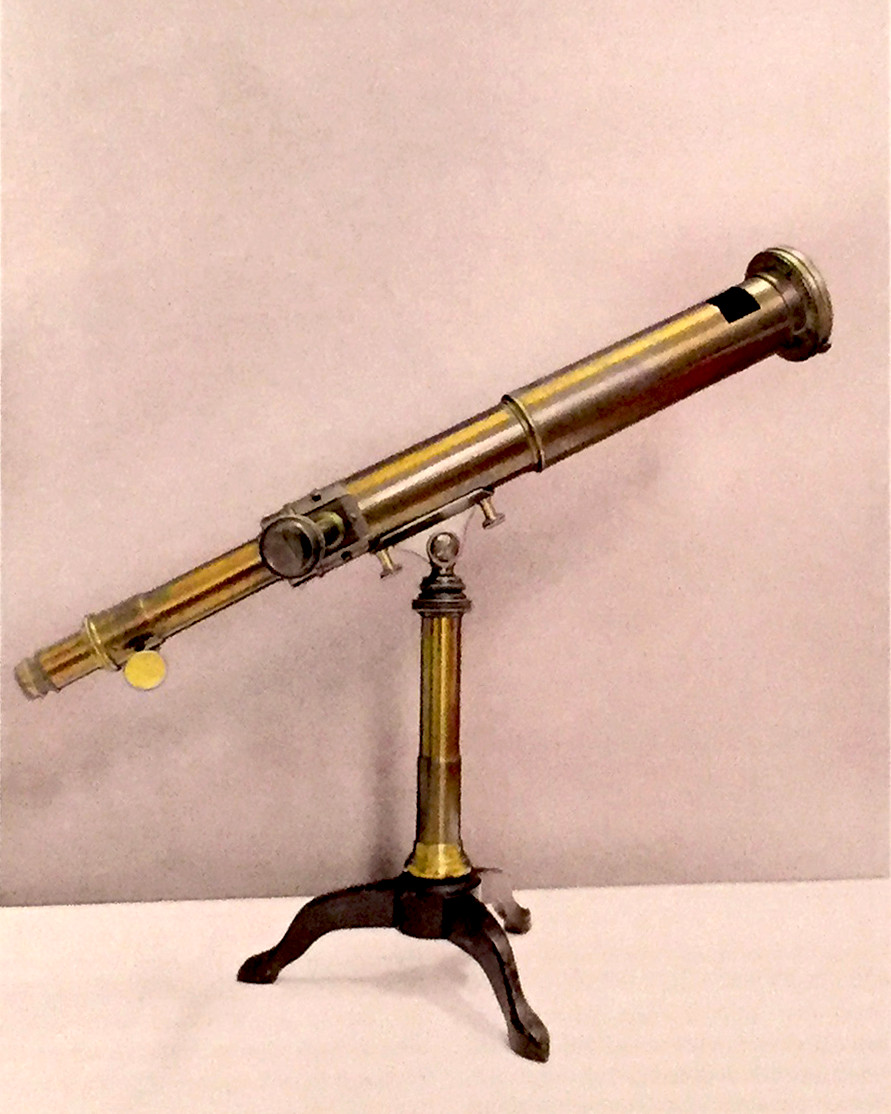
J. Hofmann, Paris 1862
Brass, glass
INAF – Rome Astronomical Observatory
By means of this direct vision spectroscope, (see Fi. 02) built by the Parisian optician Hoffman, Secchi observed his first solar spectra, on which he published an article in 1863. He had been able to test the instrument in 1862 during the visit in Rome of Jules Jannsen, who was using a similar one for his studies of the solar spectrum. Later Secchi acquired from Merz a new direct vision spectroscope, of a better quality, which he used in 1867 to make his first spectral classification of stars, consisting of three star types:
Type I – white-blue stars such as α Lyrae and
Type II – yellow giant stars such as the Sun and Pollux;
Type III – orange and red stars such as α Orionis and Antares.
Secchi’s spectral classification represented the base for later spectral classifications. Thanks to these studies it has been to determine the physical parameters and the chemical composition of stellar atmospheres; together with stellar photometry, they have been the observational basis for models describing the structure and evolution of stars and stellar systems. [a.a., m.f., f.p.]
Bibl.: Calisi 1991, p. 41; Secchi 1877; Altamore 2012.